
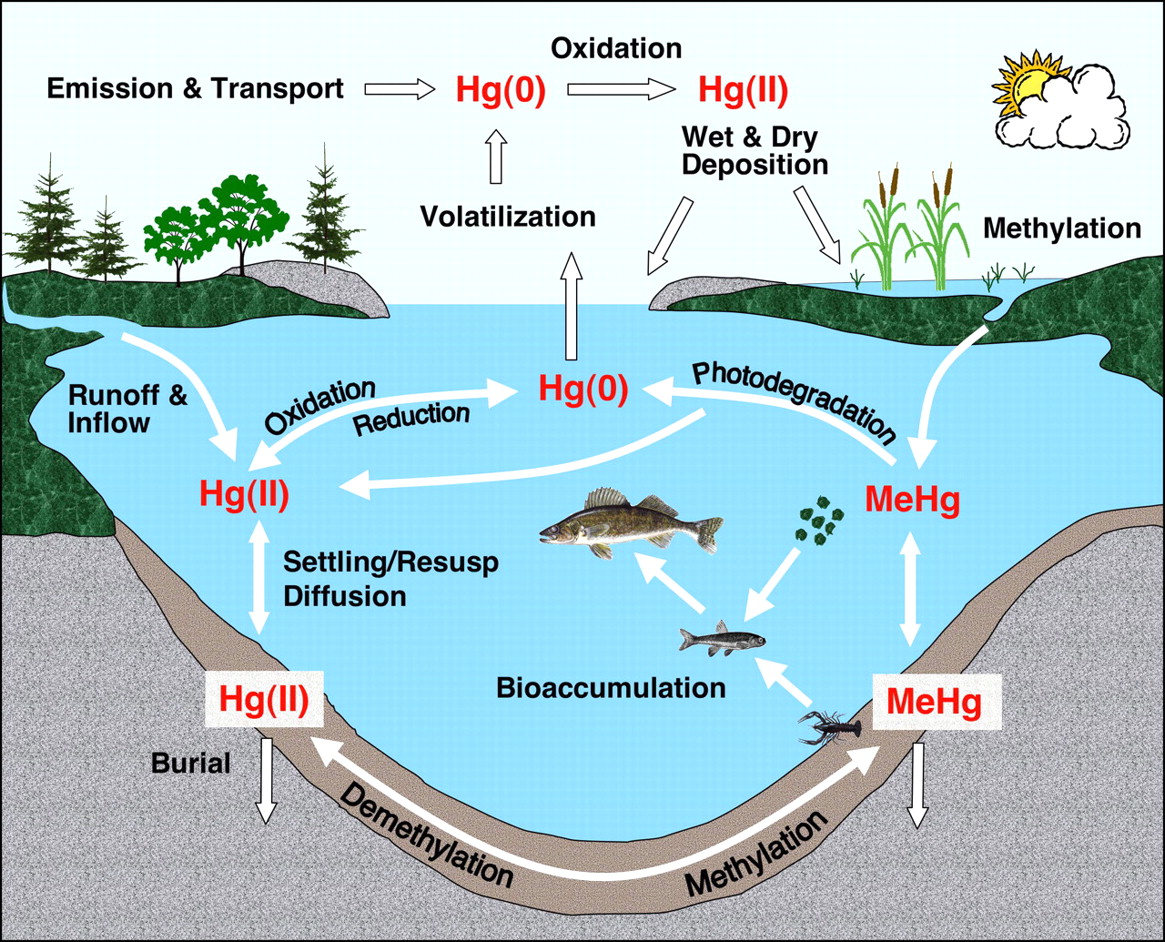
Fish mercury concentrations in lakes can exceed standards for commercial sale and result in consumption advisories for individuals.
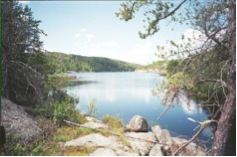 Fish mercury concentrations in lakes can exceed standards for commercial sale and result in consumption advisories for individuals. This is true even in remote areas, due to long-range mercury transport and deposition, and natural features that can lead to higher levels in fish. There are many factors that affect fish mercury levels in lakes, including the rate of atmospheric mercury deposition, water quality (e.g. acidity, dissolved organic carbon), hydrology, and food web structure. There is a need for tools to help understand how these factors combine to influence fish mercury levels and to predict the effects of changes such as reduced mercury deposition, acidity or climate change.
Mr. Harris is the lead developer of the Dynamic Mercury Cycling Model (See below – D-MCM, EPRI 2009), a Windows-based simulation
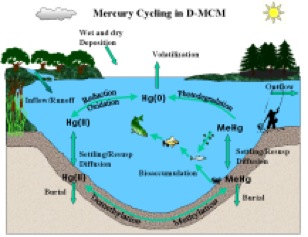
model for personal computers. D-MCM is a time-dependent mechanistic model that predicts the cycling and bioaccumulation of the major forms of mercury in lakes, including methylmercury, Hg(II), and elemental mercury.
D-MCM processes include inflows and outflows (surface and groundwater), adsorption/desorption, particulate settling, resuspension and burial, atmospheric deposition, air/water gaseous exchange, industrial mercury sources, in-situ transformations (e.g. methylation, demethylation, methylmercury photodegradation, Hg(II) reduction), mercury kinetics in plankton, and bioenergetics related to methylmercury fluxes in fish.
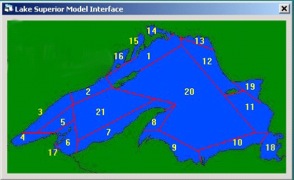
A version of D-MCM for very large waterbodies was also developed for Lake Superior. The lake is simply too big to assume conditions will be uniform throughout.
The MCM models have been applied to a wide range of lake conditions in North America, including seepage lakes in Wisconsin and Florida, drainage lakes in the Adirondacks, Ontario and Nova Scotia, and Lake Superior. D-MCM has also been used in US EPA TMDL pilot studies in Florida and Wisconsin (See below – Atkeson et al., 2003; Harris et al., 2003). The development of D-MCM has been funded by EPRI and the Wisconsin Department of Natural Resources.
References:
EPRI 2009
EPRI (2009) Dynamic Mercury Cycling Model for Windows XP/Vista – A Model for Mercury Cycling in Lakes. D-MCM Version 3.0. User’s Guide and Technical Reference. December 2009 (R. Harris lead author)
Atkeson et al., 2003
Atkeson, T.D., D.M. Axelrad, C.D. Pollman, and G.J. Keeler (2003) Integrating Atmospheric Mercury Deposition with Aquatic Cycling in the Florida Everglades: An Approach for Conducting a Total Maximum Daily Load Analysis for an Atmospherically Derived Pollutant. Integrated Summary, Final Report. Prepared by the Florida Department of Environmental Protection, University of Michigan Air Quality Laboratory, and Tetra Tech Inc., 247 pp.
Harris et al., 2003
Harris R.C., C.D. Pollman and D. Hutchinson (2003a) Wisconsin Pilot Mercury Total Maximum Daily Load (TMDL) Study: Application of the Dynamic Mercury Cycling Model (D-MCM) to Devil’s Lake, Wisconsin. Submitted to the United States Environmental Protection Agency Office of Wetlands Oceans and Watersheds. December 2003