
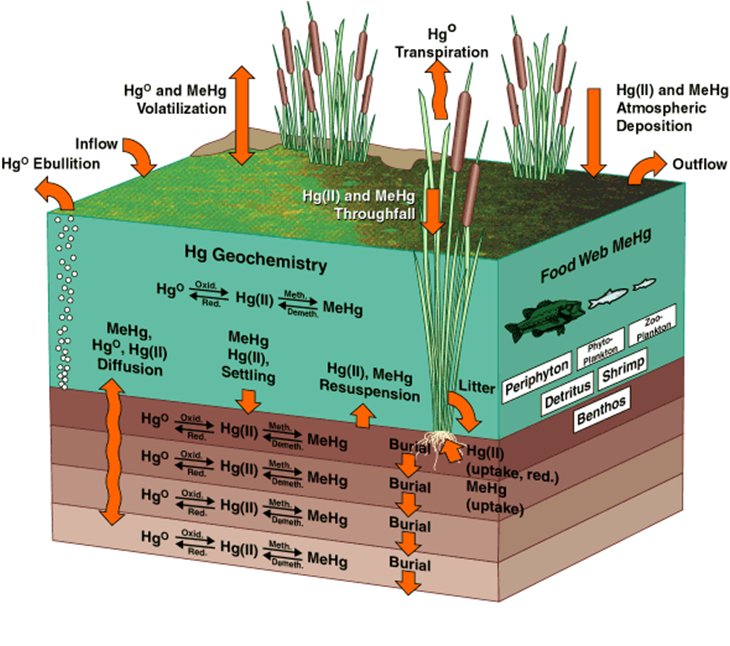
In the late 1980s, monitoring by Florida state agencies showed high levels of mercury in fish from some areas in Everglades. The problem was due to a combination of relatively high atmospheric mercury deposition and ecosystem conditions favorable to convert inorganic mercury into methylmercury, the toxic form that accumulates in fish.
Mr. Harris led a project supported by the US EPA to modify the Dynamic Mercury Cycling Model for lakes to represent marshes in Florida Everglades (See below – Tetra Tech (1999). The resulting Everglades Mercury Cycling Model (E-MCM) can also be used for wetlands generally. E-MCM has been used as a research tool and in a pilot mercury Total Maximum Daily Load (TMDL) study supported by the US EPA (See below – Atkeson et al., 2003).