
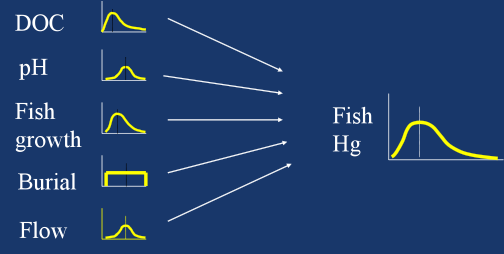
In most regions, it is not possible to monitor or simulate every lake. There are simply too many waterbodies. At the same time, no single waterbody is representative of all lakes and rivers in a region. Because of site-specific conditions, fish mercury concentrations vary widely, even among lakes close to each other with the same atmospheric mercury deposition rates.
To help address this problem, a model approach was developed that was designed to predict the distribution of fish mercury levels that exist within a region, and how this distribution would change through time if mercury deposition changed or large scale regional changes occurred for factors such as acid deposition or temperature. In a prototype study funded by the US EPA, this model was coupled with a national scale atmospheric mercury deposition model to examine the potential response of different regions to emissions controls.